
Matching an MBM booklet maker to a workflow means converting two numbers, the finished booklets produced each week and the page count of those booklets, into two published specifications, sets per hour and sheet capacity. Sets per hour determines how many finished booklets leave the machine during continuous feeding. Sheet capacity determines how thick each booklet can be. A machine that satisfies one figure but falls short on the other creates a bottleneck at the finishing stage.
Volume alone does not settle the decision, because paper size range and stitching method shape the result as well. Paper size range sets which booklet formats a machine can produce, and the stitching method governs running cost across long production runs. The sections below compare three booklet makers on speed, sheet capacity, and volume category, and explain how each specification maps to a production workload.
Which Specifications Determine Booklet Maker Speed and Volume
Four specifications determine what a booklet maker can produce, and each one governs a different limit in the finishing process. Reading them together prevents a purchase that clears one requirement and fails another.
- Sets per hour states the rate of finished booklets under continuous feeding
- Sheet capacity states the sheets stapled or stitched and folded in a single pass
- Finished page count states the booklet thickness the rated capacity produces
- Paper size and weight range sets the format ceiling for booklet dimensions
Speed and capacity move independently across models, so a faster machine is not automatically the higher-capacity machine. A throughput rating describes how quickly the machine completes a cycle, while capacity describes how much stock it closes within that cycle, and a shortlist has to be read against both figures.
Matching MBM Booklet Maker Speed to Production Volume
Production volume, counted in finished booklets, points directly to a machine class, and the MBM booklet makers range covers both bands below. Two bands cover most buying decisions in office and print finishing environments.
Low to Moderate Volume Office and Short-Run Production
Short-run booklet production means small batches produced alongside other work, not during a shift set aside for finishing. A tabletop booklet maker fits this pattern, because the batch is done in minutes and the machine sits on a desk or counter between jobs.
- Bulletins, handbooks, program booklets, and internal reports, usually 8 to 32 pages
- Batch sizes in the low hundreds rather than the thousands
- Offices, small businesses, copy shops, and print shops handling mixed daily work
High Volume and Continuous Print Finishing
High volume production changes the question from how fast the machine runs to how long it keeps running without stopping. Reloading staples or wire, clearing jams, and hand-feeding each set are what slow a long run down, so machines in this class are built to be fed by a collator instead of by an operator.
- Runs counted in thousands of booklets rather than hundreds
- Books of 48 to 80 pages, close to the limit of what saddle stitching holds
- Setups where a collator feeds the booklet maker directly, so collating, stapling, and folding happen in one continuous pass
When Sheet Capacity Matters More Than Speed
Sheet capacity decides whether a job can run at all, while speed only decides how long it takes. That distinction matters at purchase time, because a slower machine still clears a large order by running longer, and a faster machine never closes a booklet thicker than its capacity. Buyers who lead with speed usually meet the ceiling on the first job that exceeds it. Three points worth weighing before comparing rated speeds:
- The thickest booklet in the job mix sets the requirement, not the average one, so a single recurring 60-page catalog rules out a machine sized for 32-page programs
- Saddle stitching itself tops out near 64 pages, stretching toward 80 on lighter stock, which caps what any booklet maker in this class can usefully produce
- Paper choice moves that ceiling, since heavier stock reaches the same capacity with fewer sheets and pulls the finished page count down with it
Speed earns its weight once capacity is settled, and the range there runs from roughly 800 booklets per hour on tabletop machines to several thousand on production lines.
Comparing MBM Booklet Maker Speed and Volume Specifications
The table below places the three booklet makers side by side on the figures that decide the match.
| Model | Speed | Sheet Capacity | Volume Category | Standout Feature |
|---|---|---|---|---|
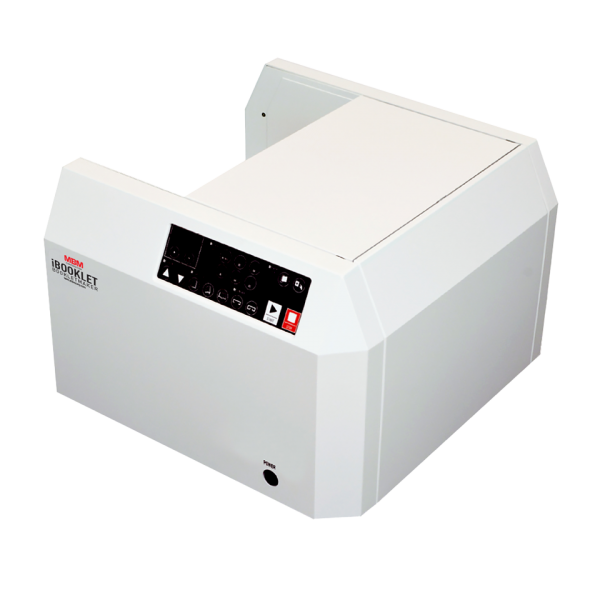
| MBM iBooklet Tabletop Booklet Maker | Up to 800 sets per hour | Up to 16 sheets | Low to moderate | Automatic feed sensor mode, flat clinch stapling, tool-free staple head positioning |
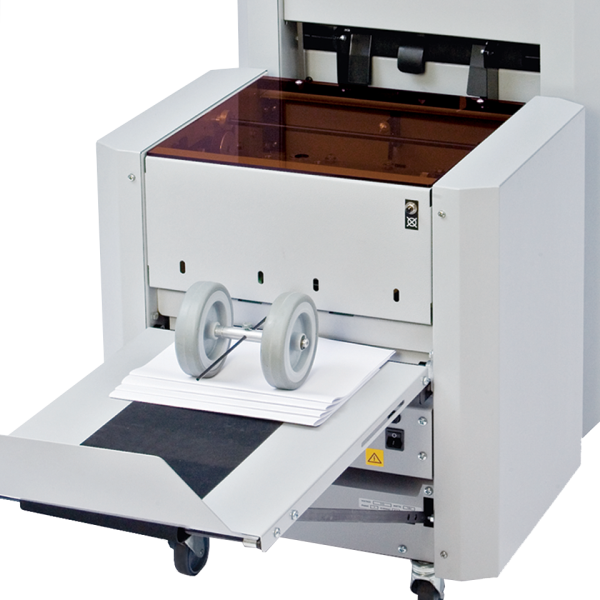
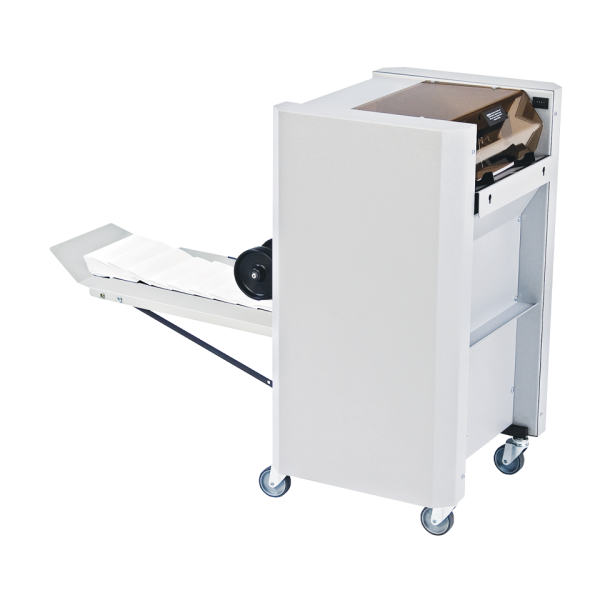
| MBM Sprint 3000 Booklet Maker | 1,500 sets per hour | 25 sheets | Moderate to high | Two stapling heads across four positions, variable speed control, foldaway powered exit conveyor |
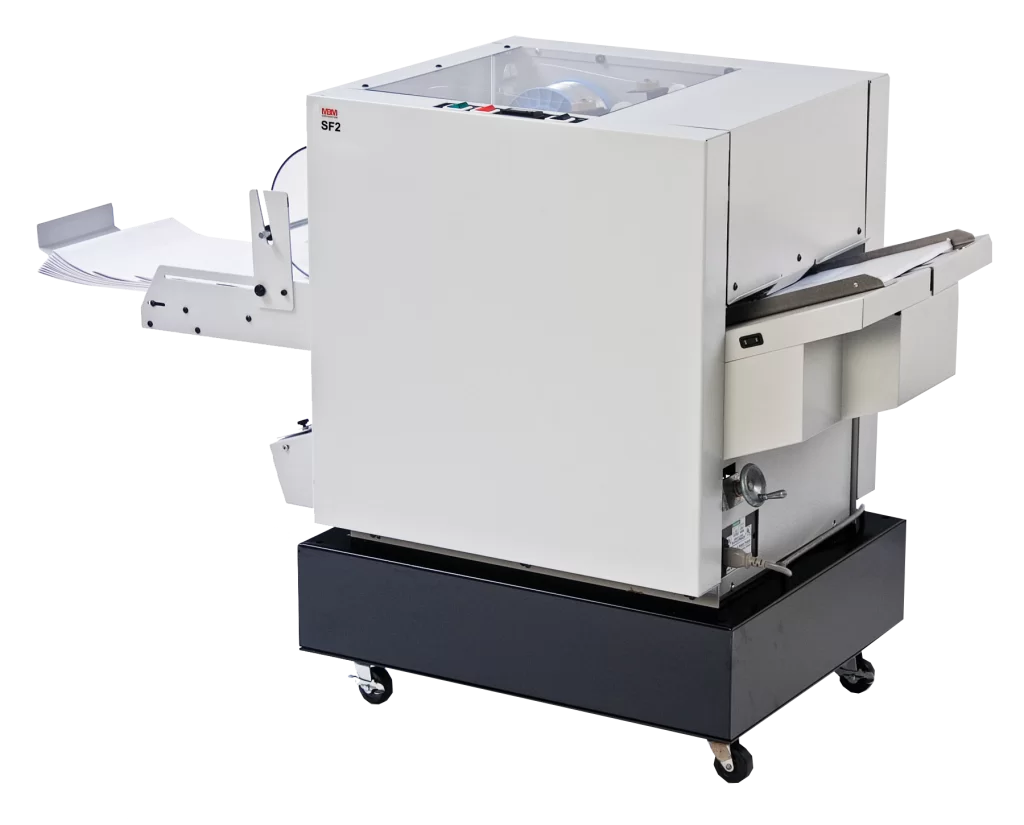
| MBM StitchFold SF 2 Wire Stitch Booklet Maker | 2,300 sets per hour | 25 sheets | High and continuous | Wire-fed stitching at 65,000 booklets per spool, adjustable staple leg length, knife fold with dual fold rollers |
MBM iBooklet Tabletop Booklet Maker
The MBM iBooklet is a tabletop booklet maker that automates stapling and folding at up to 800 sets per hour with a capacity of up to 16 sheets. It accepts paper from 16 to 80 lbs and sizes from 4.3 inch by 8.25 inch to 13 inch by 18.4 inch, and it offers saddle, side, and corner staple modes.
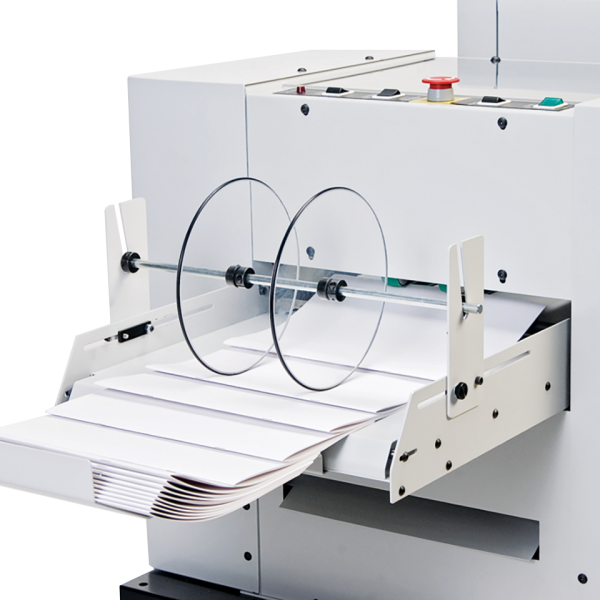
- Automatic mode uses a feeding sensor to detect inserted sheets, then staples and folds them without operator input
- Stapling and folding position adjusts to the selected paper size, with preset buttons for letter, legal, and ledger
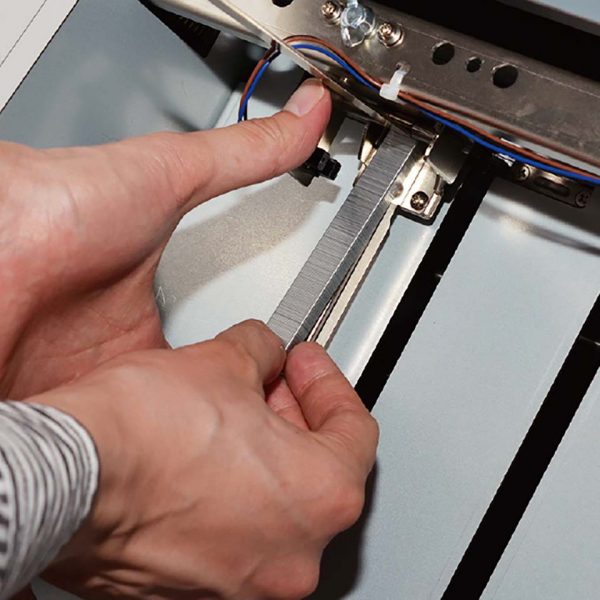
- A patent-pending stapling mechanism selects ordinary clinch or flat clinch, and flat clinch produces a flatter finished stack
- Staple head locations change across 5 slots without tools
MBM Sprint 3000 Booklet Maker
The MBM Sprint 3000 jogs, staples, and folds in one operation at 1,500 sets per hour with a 25-sheet capacity. Variable speed produces booklets up to 100 pages off-line across paper sizes from 5.5 inch by 8 inch to 12 inch by 18 inch.
- Two stapling heads and four stapling positions cover multiple booklet formats without hardware changes
- Variable speed control adjusts the production rate to the run size and the paper stock in use
- A powered exit conveyor stacks finished booklets and folds away for compact storage
- An optional interface runs the machine on-line with the MBM FC 10 collator, and an optional face trimmer is available
MBM StitchFold SF 2 Wire Stitch Booklet Maker
The MBM StitchFold SF 2 runs at 2,300 sets per hour with a 25-sheet capacity and produces booklets up to 100 pages. Its wire-fed stitching system carries lower operating costs than booklet makers using pre-formed staples, across paper sizes from 4.75 inch by 8.5 inch to 12.75 inch by 18.5 inch.
- Wire-fed stitching jogs, stitches, and folds up to 65,000 booklets before a wire spool needs replacing
- Staple leg adjustment fits staple length to the size of the book being run
- A knife fold with dual fold rollers produces crisp, consistent folds on thicker books
- An included interface runs the machine on-line with a variety of collators, and it can be paired with an optional trimmer
Selecting the Booklet Maker That Fits the Production Workload
Booklet maker selection resolves cleanly once weekly booklet count and maximum page count are written down as figures. Batch production of thinner booklets fits the 800 sets per hour and 16-sheet range of the iBooklet. Sustained production of thicker books points to the 25-sheet capacity of the Sprint 3000 or the StitchFold SF 2, with the 2,300 sets per hour rate and wire-fed stitching of the SF 2 built for the highest continuous volumes.
The full range of MBM booklet makers covers tabletop finishing through on-line production stitching. Matching published specifications to a measured workload prevents both the queue backlog of an undersized machine and the idle capacity of an oversized one. Buyers comparing models at this stage benefit from confirming page count and weekly volume before comparing price.
Need Expert Guidance on Choosing an MBM Booklet Maker?
Choosing a booklet maker comes down to booklet volume, finished page count, and how often those runs come up. Contact the expert team, call (800) 992-5279, or email for guidance on the right model.